Structured data explained
JSON Schema vs JSON-LD: what is the difference?
Use JSON Schema to validate JSON documents and JSON-LD to describe linked data. Learn where each belongs in a website or API workflow.
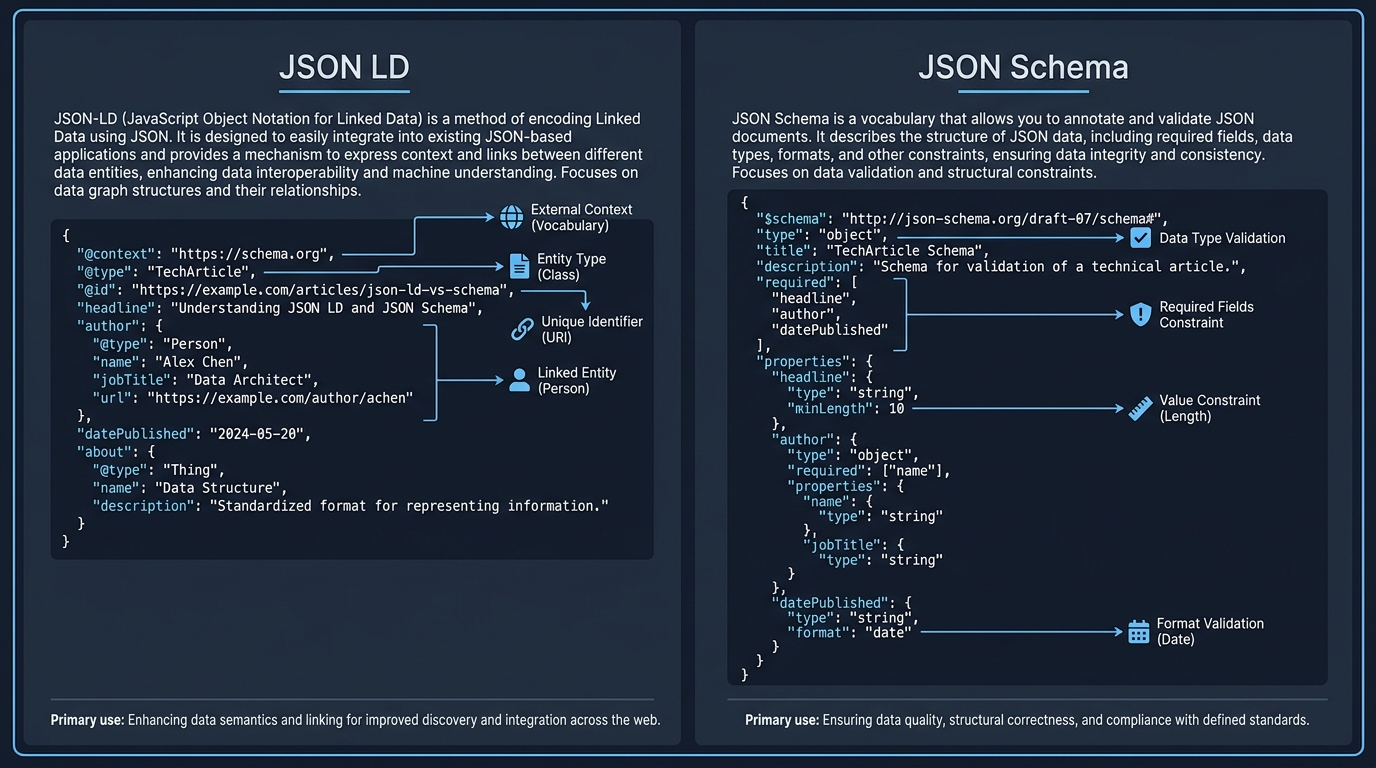
Quick answer: what each spec is for
One-sentence summary
At a high level, JSON-LD is a W3C Recommendation for expressing linked data and semantic meaning inside JSON, while JSON Schema is a separate vocabulary designed to describe and validate the shape and values of JSON documents; for many teams this means JSON-LD is the right choice for public semantic metadata and JSON Schema is the right choice for validation and API contracts, and implementers should use each where its design intent fits best, keeping the distinction clear for SEO and development workflows.
How this affects SEO and developer tooling
The practical distinction is between semantic markup and payload validation: for search-focused metadata you will typically publish application/ld+json on public pages, and for contracts and runtime validation you will rely on JSON Schema-driven tooling; the two address different problems and are often used together in the same project.
JSON-LD 1.1 is defined by the W3C as the way to express Linked Data using JSON and uses a context to map short terms to IRIs, which gives data visible on the web machine-readable semantics for entities and their relationships, and this specification remains authoritative for JSON-LD implementations W3C JSON-LD 1.1.

Core technical differences: semantics and graphs versus validation constraints
Key JSON-LD features: @context, @type, @id, and graphs
JSON-LD embeds semantics directly into JSON by using keys such as @context to map terms to IRIs and by using @type and @id to identify and connect entities in a graph model; that design makes JSON-LD suitable for publishing linked data and building knowledge graphs on the open web W3C JSON-LD 1.1.
In practice a small JSON-LD fragment attaches meaning to otherwise ambiguous property names by declaring a context, for example mapping "name" to a specific schema property IRI, so parsers treat the value as a typed entity rather than an opaque key.

JSON Schema (draft 2020-12) provides a vocabulary of validation keywords such as type, properties, required and format that express structural expectations and value constraints for JSON documents, and that vocabulary powers validators used in build pipelines and runtime checks JSON Schema Validation 2020-12.
Where JSON-LD answers "what does this value mean in a graph of things", JSON Schema answers "what shape and value types does this JSON document need to have"; the former is semantic, the latter is syntactic and constraint-focused.
How search engines use structured data and what that means for implementation
Google's preference: JSON-LD for structured data
Google Search documentation states a clear preference for JSON-LD as the format for structured data while continuing to support microdata and RDFa, so authors publishing metadata for search should favor JSON-LD unless they have a specific reason to use another syntax Google Search Central structured data intro.
For SEO, structured data is expected to be present in an application/ld+json script block and evaluated against Google's content and structured-data guidelines rather than against JSON Schema validators, which means compliance testing should include Google's guidance and relevant testing tools Google Search Central general guidelines.
What is the practical difference between JSON Schema and JSON-LD for web teams?
JSON-LD is intended for publishing linked data and semantic metadata on public pages, while JSON Schema is intended for describing and validating JSON structures in APIs and tooling; use JSON Schema for validation and JSON-LD for public semantics.
Place JSON-LD where it is discoverable by crawlers, make sure the structured data reflects the visible page content, and avoid publishing internal-only fields in public metadata to keep search evaluation and user-facing content consistent.
When to choose JSON Schema, when to choose JSON-LD, and when to use both
Use the right tool for the job: JSON Schema is the right choice for API contracts, build-time validation, runtime payload checks and contract testing, while JSON-LD is the right choice for exposing semantic metadata on public pages and for linking entities into knowledge graphs.
In API design OpenAPI 3.1 adopted JSON Schema 2020-12 for schema definitions, which illustrates the ecosystem role JSON Schema plays for APIs and tooling when specifying request and response shapes OpenAPI Specification 3.1.0.
For teams that need both validation and public semantics a common pattern is to validate internal payloads with JSON Schema and to generate or assemble JSON-LD from the validated data for publication, but mapping fields to IRIs and deciding which identifiers to expose requires deliberate design choices.
Mapping, interoperability and common implementation pitfalls
Mapping a JSON Schema for an internal model to a JSON-LD graph requires choices about identifiers, IRIs and how relationships are represented, and the specifications do not define a single standard mapping between JSON Schema and JSON-LD, so implementers must document their conventions W3C JSON-LD 1.1.
Expect decisions such as whether to generate stable @id values, how to convert types and formats, and whether internal-only fields should be excluded from published JSON-LD; these choices affect both interoperability and privacy considerations.
A common mistake is relying on a JSON Schema validator and assuming that will influence how search engines interpret a page; validation and search evaluation are separate concerns and should be tested with the appropriate tools and guidelines Google Search Central general guidelines.
Practical checklist, short examples and next steps
Checklist, short steps and next actions that implementers can use right away include choosing JSON-LD for public metadata, using JSON Schema for API validation, ensuring JSON-LD matches the visible content, and testing with Google's structured data guidance and validators Google Search Central structured data intro.

Example pattern: validate incoming payloads against a JSON Schema during ingest and map the validated fields to a JSON-LD fragment for publication, ensuring the mapping produces stable @id values and uses an explicit @context to avoid ambiguous terms JSON Schema Validation 2020-12.
Short validation steps: run JSON Schema validators in CI, confirm JSON-LD fragments appear in application/ld+json script blocks on pages, and use Google's testing or inspection tools to check for content guideline issues before and after deployment Google Search Central general guidelines.
If you need to align schemas and published metadata, document a mapping table that records field-to-IRI decisions and include examples of canonical @id generation so that future maintainers can reproduce the mapping reliably.
Frequently asked questions
Can I use JSON Schema to make my page eligible for Google rich results?
No. JSON Schema is for validation and API contracts. For Google rich results, use supported structured data such as JSON-LD and follow Google's guidelines; correct markup does not guarantee a rich result.
Should I publish internal fields in my JSON-LD?
Avoid exposing internal-only fields. Publish only the metadata that should be public and that matches visible content to prevent mismatches during search evaluation.
Is there a standardized mapping between JSON Schema and JSON-LD?
No. There is no single standardized mapping; mapping requires deliberate choices about identifiers, IRIs and which fields to expose.
Choosing between JSON-LD and JSON Schema is rarely an either-or decision. Use JSON Schema to keep your data interfaces robust and use JSON-LD to publish clear, linked metadata for search and discovery. Document your mappings, run targeted tests for each concern, and keep public metadata aligned with visible content to reduce mistakes and improve maintainability.
References
- https://www.w3.org/TR/json-ld11/
- https://json-ld.org/
- https://linkml.io/linkml/howtos/using-jsonld.html
- https://json-schema.org/draft/2020-12/json-schema-validation
- https://developers.google.com/search/docs/appearance/structured-data/intro-structured-data
- https://developers.google.com/search/docs/appearance/structured-data/sd-policies
- https://spec.openapis.org/oas/v3.1.0
- https://checkmyschema.com/learn/jsonld-graphs
- https://checkmyschema.com/learn/versions-and-updates
- https://checkmyschema.com/learn/google-rich-results