Structured data explained
What JSON Schema is used for in practice
A practical answer to what JSON Schema is used for, with clear examples of validation, constraints like minimum and multipleOf, and when to apply it.
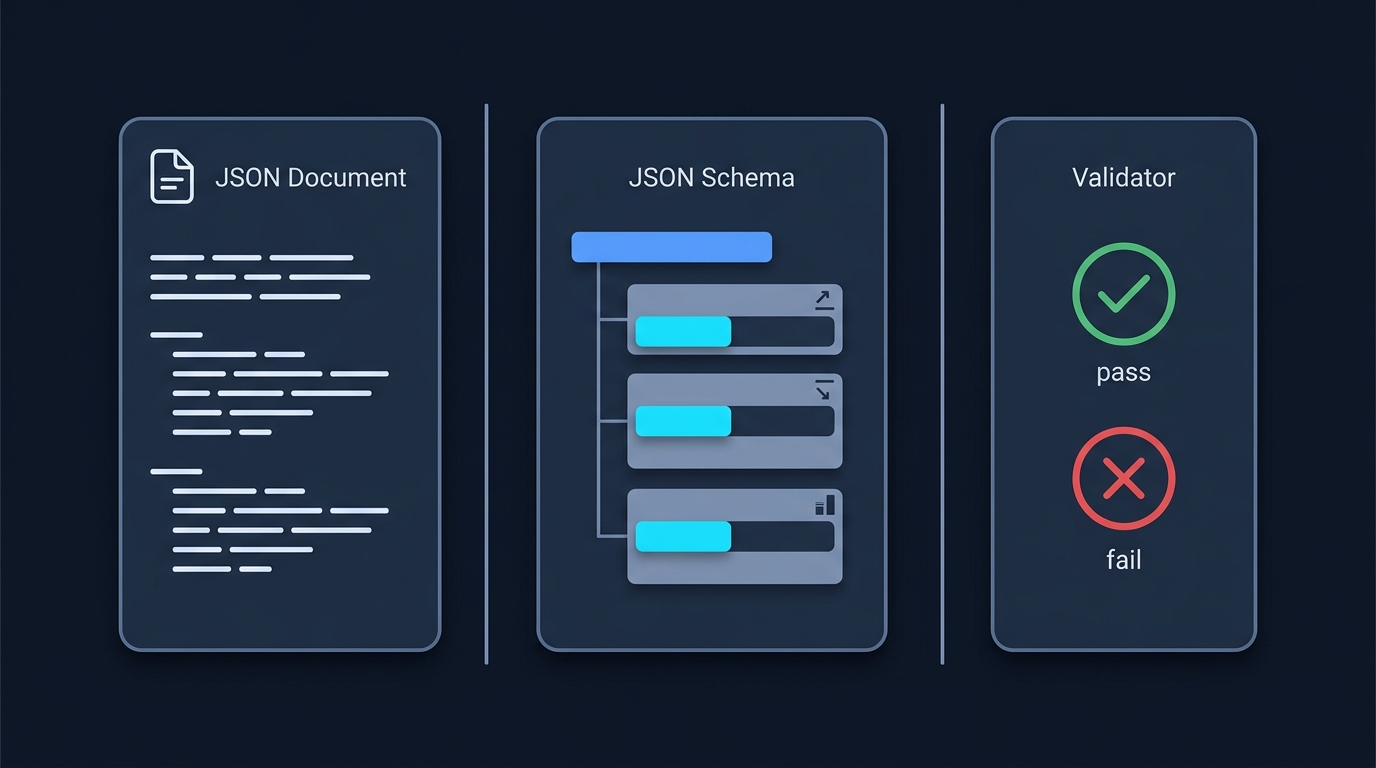
A JSON Schema is used to describe and validate the structure and content of JSON data so programs can automatically check inputs and enforce rules.
It does this with declarative keywords (for types, ranges, conditions, etc.) that validators can apply consistently across languages and environments https://json-schema.org/learn/json-schema-examples.
What you can use JSON Schema for
Validation and contracts
Define types, required fields and constraints so incoming JSON can be validated automatically before it reaches your application logic. The official examples illustrate typical schemas for addresses, products, calendars and more https://json-schema.org/learn/json-schema-examples.
Precise numeric rules
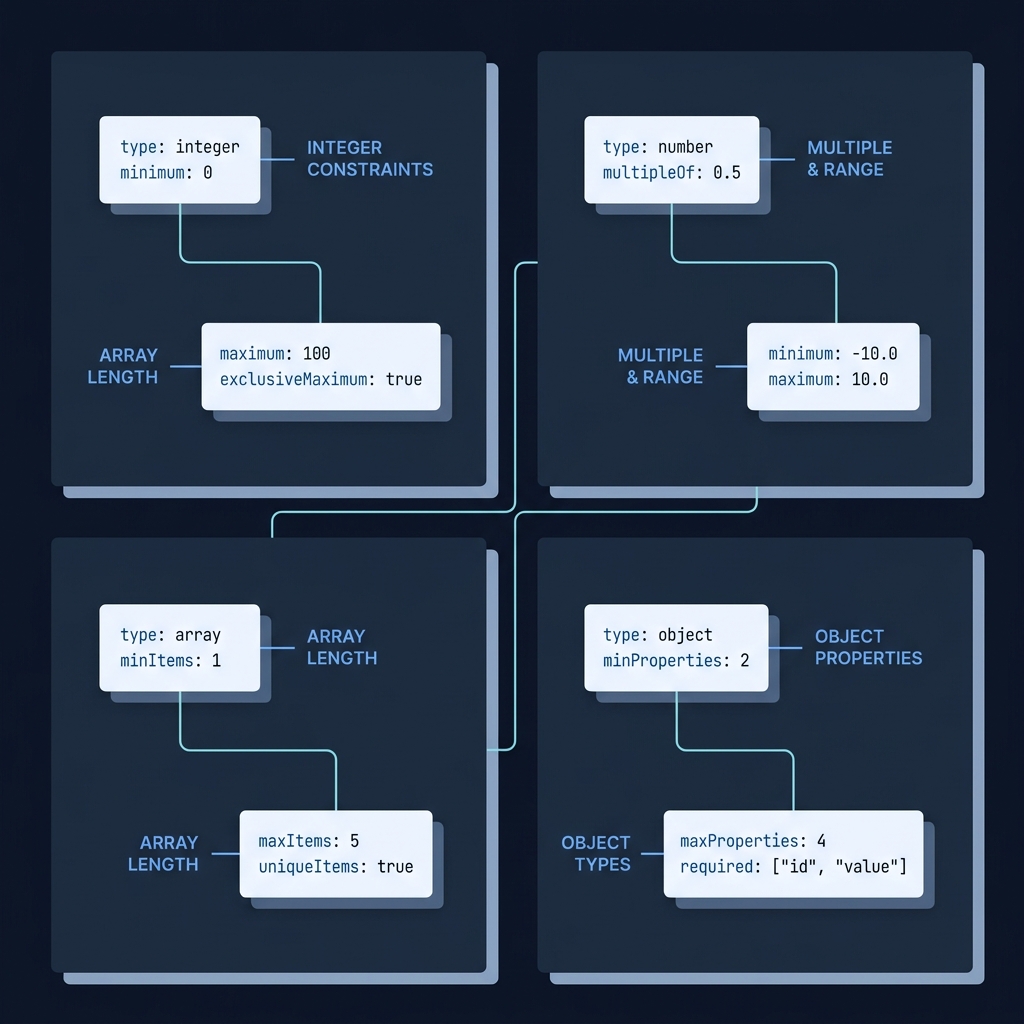
Two numeric types are supported: integer (no fractional part) and number (any numeric). In JSON Schema, values like 1 and 1.0 represent the same value and will satisfy integer when appropriate https://json-schema.org/understanding-json-schema/reference/numeric. You can also enforce ranges using minimum/maximum or exclusiveMinimum/exclusiveMaximum, and exact steps via multipleOf (for example, 0.01 for cents) https://json-schema.org/understanding-json-schema/reference/numeric.
Conditional logic
Capture real-world dependencies, such as “if foo exists, bar is required” with dependentRequired, or full if/then/else conditions for different scenarios https://json-schema.org/learn/miscellaneous-examples.
When JSON Schema is a good fit
Great matches
- API request/response validation and documentation.
- Data exchange between services or teams where shape must stay consistent.
- Configuration files and pipelines that benefit from editor hints and strict checks.
Possible overkill
- Quick one-off scripts or prototypes where inline checks are faster than designing a schema.
- Binary or non-JSON formats where other validators are more appropriate.
Note: Some editors and tools let you place $schema in a JSON document to hint which schema to use, but this is not part of the JSON Schema standard for arbitrary data instances; it is an editor/tooling convention. The standards discussion confirms this distinction https://github.com/orgs/json-schema-org/discussions/473.
Practical examples you can adapt
Prices with cent increments
Type: number. Use multipleOf: 0.01 to enforce two-decimal steps, and add minimum/maximum for allowed ranges https://json-schema.org/understanding-json-schema/reference/numeric.
Age as a whole number with bounds
Type: integer. Set minimum: 0 and a sensible maximum. Remember that 30 and 30.0 represent the same value and satisfy integer according to the spec https://json-schema.org/understanding-json-schema/reference/numeric.
Sensor thresholds
When a limit must be strict, use exclusiveMaximum so values equal to the limit are rejected while lower values are accepted https://json-schema.org/understanding-json-schema/reference/numeric.
How to apply JSON Schema effectively
Start small, then iterate
Capture the most important fields and constraints first: types, required properties, and any must-have numeric rules. Expand as the contract stabilizes. The official examples page is a helpful pattern library when you need objects, arrays, enums or conditional dependencies https://json-schema.org/learn/miscellaneous-examples.
Test with representative instances
Keep a few valid and invalid JSON samples beside your schema and run them through a validator locally and in CI. Include boundary values to confirm inclusive vs exclusive behavior for ranges https://json-schema.org/understanding-json-schema/reference/numeric.
Apply JSON Schema with confidence: a quick checklist
Common mistakes to avoid
Mixing up integer and number
In JSON Schema, 1 and 1.0 represent the same value; an instance like 1.0 can satisfy integer. Pick integer only when fractional values must be disallowed https://json-schema.org/understanding-json-schema/reference/numeric.
Unclear boundaries
Be explicit about inclusivity with minimum/maximum versus exclusiveMinimum/exclusiveMaximum, and test exact boundary values to avoid surprises https://json-schema.org/understanding-json-schema/reference/numeric.
Assuming $schema in data is standard
Using a $schema property inside ordinary JSON data to select a schema is not standardized for instances; it is a common editor feature and should not be relied on for production validation unless your tooling explicitly supports it https://github.com/orgs/json-schema-org/discussions/473.
FAQ
Can JSON Schema enforce that a number has no decimals?
Yes. Use type: integer. Per the spec, values with a zero fractional part (e.g., 1.0) are considered integers for validation https://json-schema.org/understanding-json-schema/reference/numeric.
How do I enforce a two-decimal price?
Use multipleOf: 0.01 and add minimum/maximum as needed for your business limits https://json-schema.org/understanding-json-schema/reference/numeric.
Can I express conditional requirements?
Yes. Keywords like dependentRequired and if/then/else capture conditional logic; see the official examples https://json-schema.org/learn/miscellaneous-examples.

Related guides
Related guide from Stack & Method
When an API data contract changes, the next decision is compatibility. See What is API versioning? Practical guidance for small teams.